
What Is a Dharma Trip?
More than a holiday with your sangha
A dharma trip is a journey in which the travel itself is the practice.
Most of the travel we do is with people we chose: family, close friends, people who see the world roughly as we do. A dharma trip starts from a different premise. You travel with your teachers and ten, twenty or thirty fellow practitioners, for a week or more, and the whole journey becomes a place to practice: on the bus, at the meal, in the unfamiliar hotel room.
The places are real and often extraordinary. But the point isn’t what you see. It’s what travel shows you about how you live, and who you can become when your usual routines aren’t there to hold you up.
“On a dharma trip, it’s really a crucible where all the issues get distilled.”
— Catherine Pawasarat Sensei
Why travel works
Travel loosens the conditioning we grew up inside, which is hard to do any other way.
In the Namgyal tradition, growth and unfoldment can happen in two ways. One is developing better states of being: how we are in this moment, how steady, open and kind. The other is working through the stages of conditioning that hold us in a box, the assumptions of our family, culture and religion that may be old, or may no longer fit a changing world. Travel invites both. It challenges the familiar from the first day, and the practice gives us the steadiness to meet that challenge well.
Both Catherine Sensei and Qapel traveled widely as a young people, and lived in a number of countries, including Japan. Catherine Sensei says it takes a great deal to deconstruct the conditioning we’re raised with, and that living in other cultures helps us become more people of the planet: more able to connect across languages, backgrounds and ways of seeing. Add the teachings and the path, and travel becomes one of the most powerful parts of the journey.

Community on the road
On a dharma trip you can’t go home to your room, your routines or your inner sanctum, and that is much of the gift.
A spiritual path gives us a different circle than friendship does. The people you meet share your aspiration to grow and unfold, but they may not be people you would have chosen as friends. On the road you share buses, meals and rooms with them, day in and day out. Sometimes we assign roommates, partly so someone gets a break and partly so someone gets gently stimulated.
Few of us have a community on the ground, with more than a handful of people we live alongside. A dharma trip offers a community on the road, which is harder in some ways and richer in others. Whatever arises, we work through it together, as individuals and as a group. Our habits get a gentle shake all day long, and the group helps us find our footing again.
How we travel
We design our own itineraries around the most wholesome of what a place has to offer.
That means seeking out cutting-edge community development, cooperatives, eco-friendly places to stay, and indigenous-led projects. When we began, much of this barely existed, and we felt a gap between how we wanted to live and how we were traveling. As sustainable tourism has grown, we’ve been glad to organize our travel around it: to support what’s emerging, learn from it, and bring it home.
We also try to learn a word or two of the local language. It tends to be entertaining for the locals, and it opens doors.
A lineage practice
Traveling to teach is rooted in the Namgyal tradition. Namgyal Rinpoche taught by leading retreats and courses in places like Italy, Greece and Australia, sometimes living in one country for a year or more, and he took students with him. For many years, Qapel and Catherine Sensei traveled with their students most years as part of the practice. Dharma trips carry that method forward.

Stories from the road
The best way to understand a dharma trip is through what happens on one.
Where’s the Indian food?
In a nice hotel in India, the buffet was beautiful and held not a single Indian dish. Catherine Sensei asked the manager why. He said they don’t put it out because no one eats it. When she said we would love some, he brought out the food the kitchen staff eat: a big platter of dal and rice. The kitchen team came to the restaurant door to see who was ordering it. Left alone, none of the students would have asked, because we settle into eating what’s put in front of us. A dharma trip teaches us to make a request, and to look beyond what’s presented.
The monk in Bhutan
Our group of thirty traveled in Bhutan with a Bhutanese team, including a guide and a Buddhist monk who helped interpret for us. We were saying mantras and counting malas all the time. The monk could hardly believe how much we practiced, and it challenged him to look closely at his own practice. By the end he had developed a deep devotion to Qapel, and our Bhutanese hosts were floored by the change in him.
The wrong turn in Patagonia
We were about twenty people on a bus, on the one day of the trip we spent driving from morning to evening. Close to dinner, the driver told us he had taken a wrong turn two hours down a private driveway on an enormous ranch. That meant two hours back, plus the rest of the journey. Everyone wanted off the bus, and we couldn’t get off. It threw us back on our practice, and the group made it easier: if they can do this, so can I. We arrived in reasonably good states.
The bottle of liqueur
On one trip, a student generously gave Qapel a bottle of locally made liqueur. He thanked her and asked if she would carry it back to Japan for him. She was stunned. She didn’t sleep that night, and the next day told him how surprised she was at her aversion to such a small thing. For her it was never about a bottle. She was an outstanding packer, with no wasted space in her bag, and the request touched a whole way of keeping her world in order. That kind of teaching doesn’t come up anywhere else.


Where we’ve been
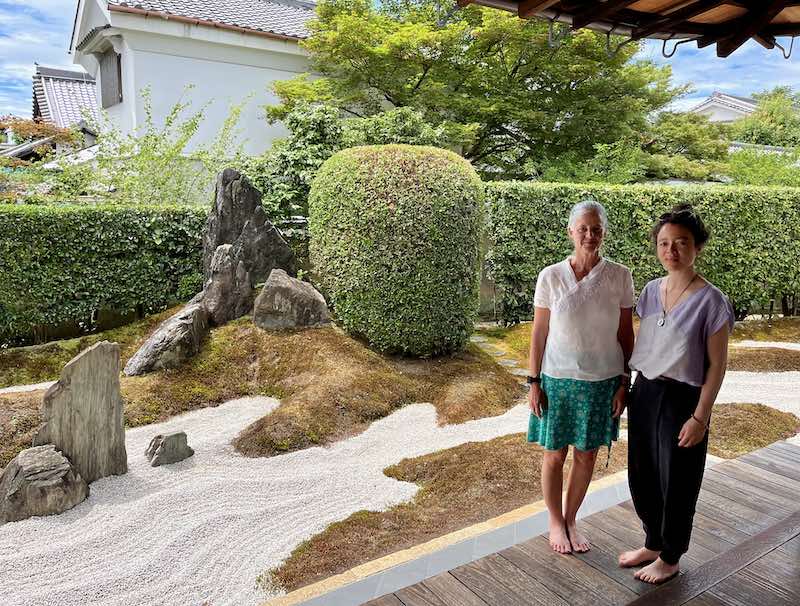
Catherine Sensei and Qapel have led dozens of dharma trips across every continent, Antarctica included. This is in addition to trips they attended with Namgyal Rinpoche.
A representative sample: Uzbekistan and Kyrgyzstan, Bhutan, Argentina, Brazil, Mexico, South Africa, Australia, Cambodia, Laos, Burma, Turkey, the United Kingdom, France, Germany, Indonesia, Greece, Israel and Egypt.
The Stans
In a 2022 conversation, Qapel described a trip he was dreaming of for his seventy-fifth birthday: the Silk Route “Stans,” taking in Samarkand and Tashkent. It would be rougher than most, he said, and not the kind of trip someone takes for a holiday. It was the sort of place you go because you need a dharma trip. Qapel passed away in October 2024. Ten months later, sangha traveled to Uzbekistan and Kyrgyzstan with Catherine Sensei as a memorial journey.


Antarctica
In 2006, Qapel took a group of students to Antarctica aboard an old research vessel. Unlike anywhere else we’ve traveled, the journey meant tough and at times dangerous conditions, with almost nothing familiar to fall back on. It echoed Qapel’s own training: in the 1960s and ’70s, Namgyal Rinpoche took his students on freighter voyages around the world lasting three to six months. Antarctica was a dharma trip in its most concentrated form.
Filmed by students during the 2006 trip, and edited and produced by Qapel.
What’s Expected of Me?
A dharma trip asks for presence and an open heart more than any particular experience.
It’s easy to mistake one for a holiday somewhere exciting. There will be plenty of sightseeing, but the trip is about bringing your growth to the road. A single day can be exciting, challenging, joyful and exhausting all at once. What helps most:
- Come with an open mind and heart. Some apprehension about new places and new people is human. A spirit of adventure helps.
- Bring a constant question: how can I grow, and how can I support the teacher and the community?
- Be on time. It keeps the group grounded and the days moving as planned.
- Check your capacity. Days are full and often involve a lot of walking. Make sure you have the energy and bandwidth for that in your current season of life.
If you’d like to know whether a particular trip suits you, a previous relationship with Catherine Sensei or the sangha is recommended, and the trip coordinator is happy to talk it through.
Joining a Trip
Each trip has its own page with dates, a draft itinerary and a trip coordinator. Coordinators are fully paying participants who offer their time as part of their karma yoga practice, so please read the trip page closely before you write to them.
The teacher is offered dāna. Flights and the trip’s accommodation and activity budget are separate, and each trip page spells them out. You can learn more about dāna here.
Meet the Teacher
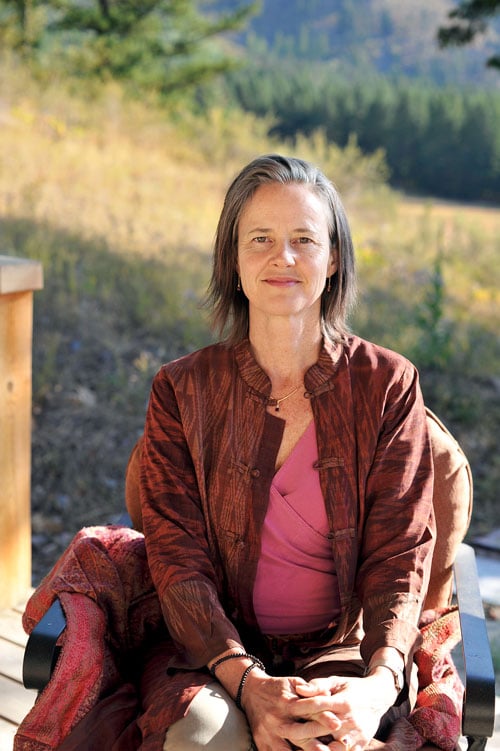
Catherine Pawasarat Sensei
Catherine Pawasarat Sensei is a dharma teacher and co-founder of Clear Sky Retreat Center and Planet Dharma, carrying forward the Namgyal Rinpoche tradition of planetary awakening. She trained daily with Acariya Doug Duncan (Qapel) for 26 years, until his passing in 2024, in an apprenticeship that is rare in the modern West, and received lay ordination from Namgyal Rinpoche in 2003.
Awakening through travel is a central pillar of this lineage, and Catherine Sensei has made it her own. She has led and joined dozens of dharma trips across every continent, Antarctica included, most recently through Uzbekistan and Kyrgyzstan. A former advocacy photojournalist who has lived in the Amazon and spent twenty years studying traditional Japanese arts in Kyoto, she brings the same blend of curiosity and practicality to the road.
More About Sensei | About the Lineage

Online
In-Person
Library